Project Overview

Streamlining Quote-to-Cash Workflows in Enterprise ERP Systems

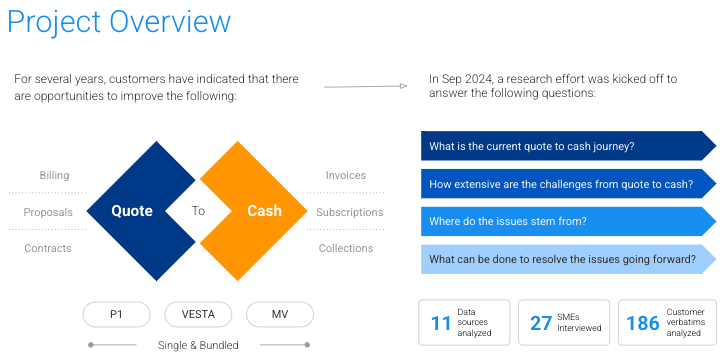
This foundational research focused on the quote-to-cash journey for Premier One, VESTA, and MV products. The work was designed to uncover why customers were experiencing long-standing friction across contracting, ordering, deployment, and billing, then translate those findings into clear priorities for product and operational improvement.

Quote-to-cash overview artifact showing process questions, products, and research scope
Role
Lead UX Researcher
Duration
1 month sprint
Users
Cross-functional internal teams and subject matter experts
Request Origin
Office of the CTO
Team
UXR interns, Data Scientist, Senior UXR, UXR Manager, UXD Manager, Chief of Staff of Devices & Customer Experience, and VP of Command Center Software
End to end

Mapped the quote-to-cash journey from pre-sales through renewal and expansion.

20+

Specific recommendations generated to improve workflow clarity, handoffs, and customer experience.

3 to 5

Priority opportunity areas identified to guide roadmap and operational alignment.

The challenge

What needed to be understood

Customers had been reporting dissatisfaction across the quote-to-cash process for years, but the organization lacked a shared view of where the breakdowns were happening and why. Contracting, invoicing, order changes, deployment handoffs, and renewal workflows were all contributing to friction, yet the experience had never been mapped holistically.

What the research needed to deliver

  • Map the full journey across touchpoints, systems, and teams.
  • Identify the most severe and recurring pain points.
  • Connect operational delays to lived customer experience.
  • Turn findings into product and process recommendations leadership could act on quickly.
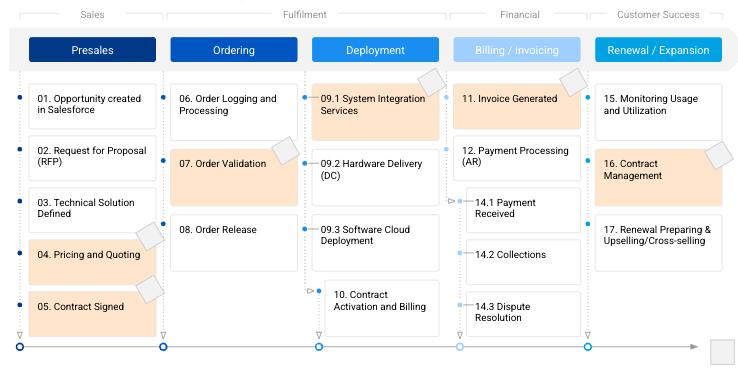
Journey map artifact showing pre-deployment, deployment, and post-deployment stages with customer pain points and delays
The research centered on a journey map that made the breakdowns visible across stages, teams, and time. It gave stakeholders a shared picture of where delays, handoff issues, and customer frustration were clustering.

Research Methods

I used a mixed-methods approach so the team could understand not only what was happening in the workflow, but how those breakdowns were showing up in customer experience.

Operational evidence

  • Quantitative analysis: Investigated sales and supply chain data to uncover process insights, contract lag, and the stages that took the longest.
  • Workflow diagnostics: Used system and operational patterns to frame where friction was likely accumulating before qualitative work went deeper.

Direct stakeholder input

  • In-depth interviews: Conducted one-on-one conversations to explore experiences, behaviors, and root causes in detail.
  • Focus groups: Facilitated shared discussions to gather multiple perspectives and understand how cross-functional dynamics shaped the experience.

Pattern validation

  • User surveys: Collected broader, quantifiable input to validate emerging themes and spot trends quickly.
  • Synthesis and prioritization: Organized findings into journey stages, pain point clusters, and opportunity areas the team could act on.

The Process

Moving from scattered signals to a shared experience map.

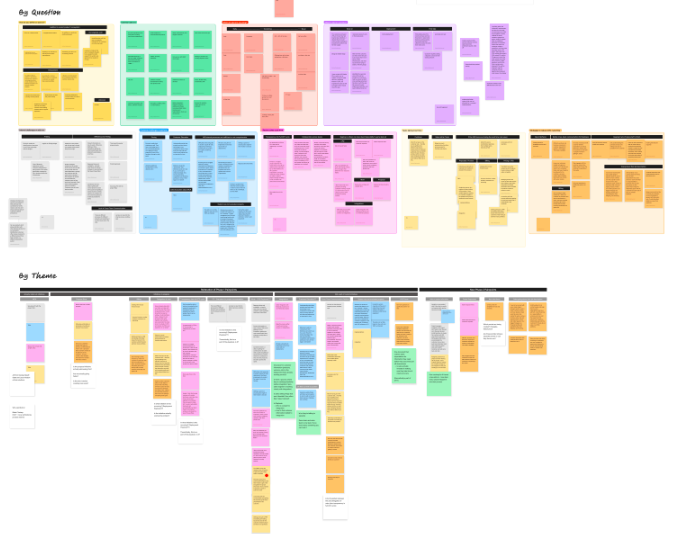
The research was structured to build clarity in layers, starting with the problem framing and operational evidence, then expanding into direct user input, synthesis, and strategic recommendations.

01

Planning

  • Defined the core research goals and aligned on what needed to be understood across the quote-to-cash journey.
  • Built the research plan, timeline, and method stack.
02

Journey framing

  • Mapped the major stages, products, and transition points across Premier One, VESTA, and MV workflows.
  • Identified where contracting, ordering, invoicing, and deployment complexity were likely intersecting.
03

Research execution

  • Collected qualitative input through interviews and focus groups.
  • Used surveys and operational data to validate themes and identify broader patterns.
04

Analysis

  • Analyzed the journey by touchpoint, pain point, and business consequence.
  • Connected workflow bottlenecks to customer dissatisfaction, especially around order changes and invoicing.
05

Recommendations

  • Translated findings into actionable recommendations across pre-sales, ordering, deployment, billing, and renewal.
  • Delivered a report that helped leadership align around root causes, ownership, and next-step opportunities.

Findings & Insights

The research made it clear that dissatisfaction was not tied to a single product issue. It came from accumulated friction across the quote-to-cash workflow, especially where systems, teams, and billing structures failed to align.

Contract and invoice complexity was a primary pain point

A one-to-many relationship between contracts and invoices created confusion, administrative burden, and ongoing dissatisfaction for customers managing multiple active agreements.

Invoicing and billing were the weakest touchpoints

Customers consistently rated invoicing and billing as the least satisfactory part of the experience, especially around accuracy, timeliness, and interpretability.

Order and deployment handoffs amplified friction

Difficult quoting systems, manual workarounds, and siloed product teams created instability between ordering and deployment, often forcing change orders or rework.

Cycle times varied, but implementation often dragged longest

The duration data showed that implementation was frequently the slowest and most painful stage, making delays more visible to customers and more expensive for the business.

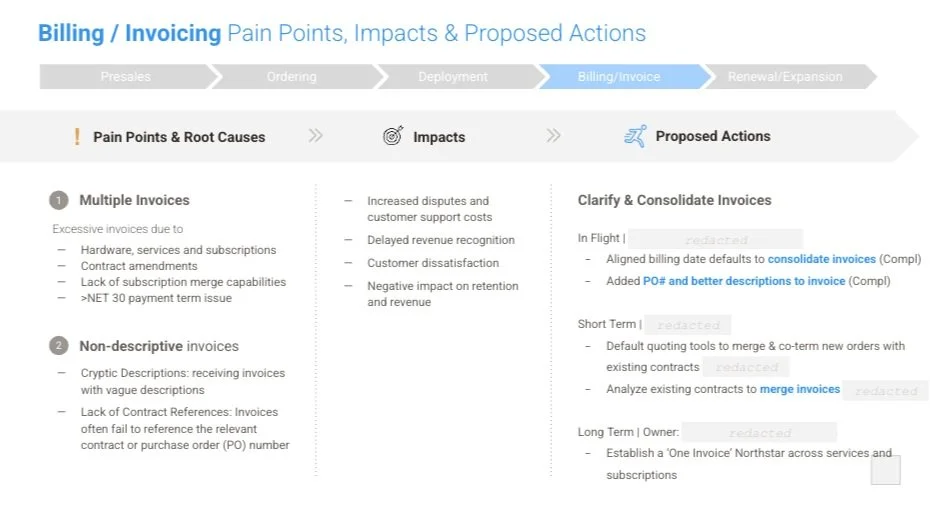
Findings slide highlighting key quote-to-cash issues, invoice pain points, and cycle time observations
A redacted findings snapshot showing how the research translated journey-level pain points into concrete experience and business issues.

Business Impact

What the work made possible

The project created a shared, evidence-backed understanding of where the quote-to-cash experience was breaking down, helping product and operational leaders align around improvements that could reduce dissatisfaction and improve business efficiency.

Clearer

Visibility into the full quote-to-cash journey across pre-sales, ordering, deployment, billing, and renewal.

20+

Specific recommendations generated to improve product workflow, handoffs, and communication.

3 to 5

Key opportunity areas identified for roadmap alignment and cross-functional ownership.

Earlier

Stronger direction for where operational, billing, and deployment improvements could have the biggest customer impact.

Deliverable Snapshot

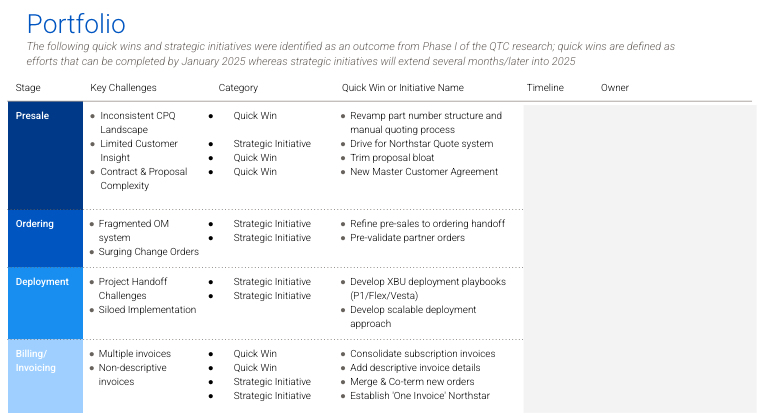
The final research package was designed to support roadmap conversations, operational alignment, and long-term experience improvements across the enterprise workflow. Redacted to keep confidentiality.

Learning & Reflection

This project reinforced how important it is to frame enterprise workflow research at the right level of abstraction. The quote-to-cash journey touched so many teams, systems, and business rules that the real challenge was not just collecting data. It was creating a structure that made those interdependencies understandable.

Looking back, I would scope the journey content even more selectively from the start, especially around the duration metric and how it should be visualized. I would also think more critically about whether focus groups were the best fit, since they introduced additional complexity during analysis.

The work also underscored how valuable it is to bring quantitative partners in earlier. Tying the operational signals to the qualitative experience was one of the most useful parts of the project, and even more alignment up front would have made that synthesis stronger and faster.