Project Overview

Redesigning the Deployment Experience for Mission-Critical Software

A mixed-methods research initiative focused on understanding the deployment journey end to end, surfacing what was breaking down after the sale, and giving product and leadership teams a clearer path forward.

Command center software interface used during deployment and operations
Role
Lead UX Researcher
Timeline
6 months
Team
Interns, Data Scientist, Senior and Manager-Level UXRs, VP of Command Center Software
Users
Command Center Software Customers and MSI Deployment Staff
Initiated By
Office of the CTO
5 phases

Mapped across the deployment experience from contract to post-launch adoption.

25+

UX recommendations delivered across onboarding, navigation, and support flows.

3 focus areas

Identified for roadmap alignment, resource planning, and post-sales improvement.

The challenge

What was going wrong

The company lacked a clear understanding of the end-to-end deployment journey, which led to misaligned product decisions, unresolved pain points, and inefficiencies across the software lifecycle.
What success needed to look like

  • Map the full journey from contract to deployment.
  • Identify pain points, gaps, and unmet needs.
  • Align product features with real user expectations.
  • Improve satisfaction and reduce post-sale friction.
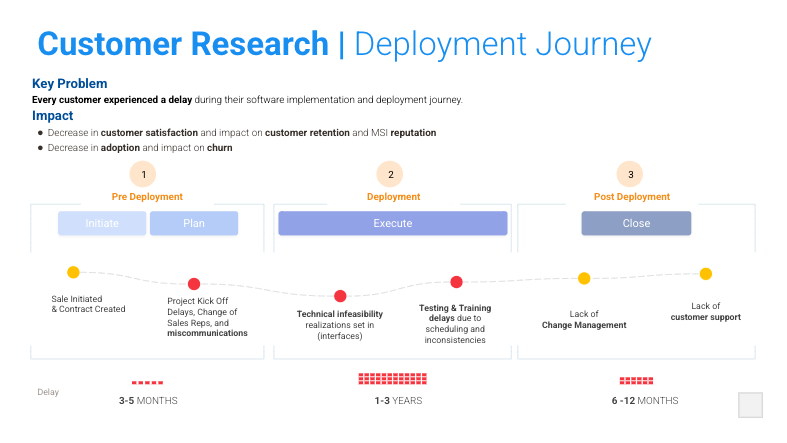
Deployment journey artifact showing phases, delays, and pain points across the customer experience

Research Methods

I used a mixed-methods approach so the team could understand not just where deployment was breaking down, but why.

Operational signals

  • Quantitative analysis: Reviewed supply chain and sales data to isolate patterns, delays, and operational friction.
  • 60+ survey responses: Validated early themes and surfaced larger patterns across the deployment experience.

Direct user input

  • 15 interviews: Spoke directly with customers and internal partners to understand deployment challenges in context.
  • 3 focus groups: Captured shared pain points, differences in perspective, and group-level dynamics.

Synthesis & sensemaking

  • Affinity mapping: Used structured synthesis in Dovetail to organize evidence and make themes actionable.
  • Cross-method triangulation: Brought qualitative and quantitative evidence together to identify the highest-impact breakdowns in the deployment journey.

The Process

From ambiguity to an actionable deployment map.

I structured the work so each phase reduced uncertainty for the next one, from stakeholder alignment and participant recruitment through synthesis and delivery.

01

Planning

  • Defined research objectives with stakeholders from the CTO’s office.
  • Built a mixed-methods plan across quantitative and qualitative workstreams.
  • Created detailed interview guides, survey instruments, and protocols.
02

Recruitment

  • Screened and selected diverse participants from customer and internal datasets.
  • Targeted users with recent deployments across multiple regions and roles.
03

Execution

  • Conducted remote interviews and moderated focus groups.
  • Launched surveys to deployment leads and software users.
  • Collaborated cross-functionally with the data science team to integrate sales insights.
04

Analysis

  • Transcribed and coded interviews using open, axial, and selective coding.
  • Ran affinity mapping workshops to identify experience themes.
  • Used survey data to triangulate and prioritize high-impact issues.
  • Mapped the full deployment journey by user mindset, actions, and tools.
05

Synthesis & Delivery

  • Created a five-phase customer journey map with pain points and opportunities.
  • Delivered an executive summary, full insight report, and design-ready artifacts.
  • Presented findings to VP and cross-functional stakeholders in strategic workshops.

Findings & Insights

The most valuable outcome of the research was not a single issue. It was a clearer picture of where the experience broke down across product, process, and support.

"I love the software's features, but navigating between them feels like a maze."User 27, Interview
"The onboarding process was overwhelming. I felt lost and didn't know where to start."Participant 3, Focus Group

Navigation was slowing people down

Navigation confusion repeatedly surfaced after deployment, especially once users moved beyond initial setup.

Handoffs were creating friction

Product, deployment, and customer success were not handing off information in ways that felt clear to users.

Workarounds filled the gaps

Users relied on tribal knowledge and informal support, which pointed to deeper usability and adoption issues.

Support content was out of sync

Documentation often failed to reflect real workflows, reducing confidence during deployment and onboarding.

Business Impact

What the work made possible

The research gave teams a shared, evidence-backed view of the deployment experience and a clearer set of priorities to act on.

25+

Recommendations delivered to improve onboarding, navigation, and documentation.

3

Strategic focus areas identified for roadmap and experience alignment.

1

Shared journey map used to create clearer visibility across post-sales teams.

Faster

Internal deployment resources were better targeted, reducing time-to-deploy.

Deliverable Snapshot

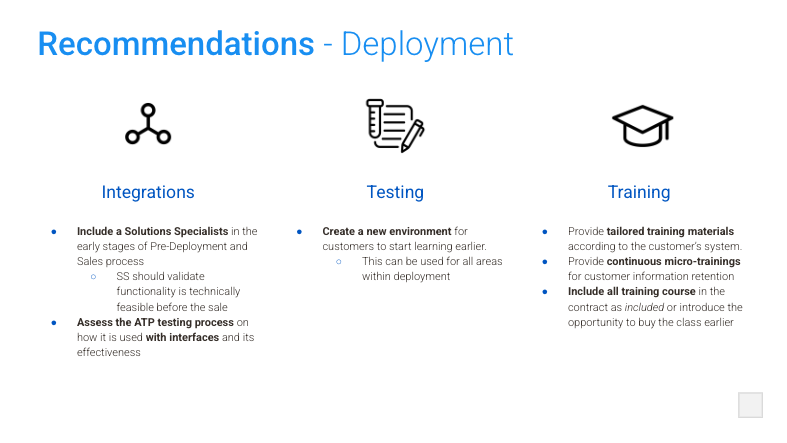
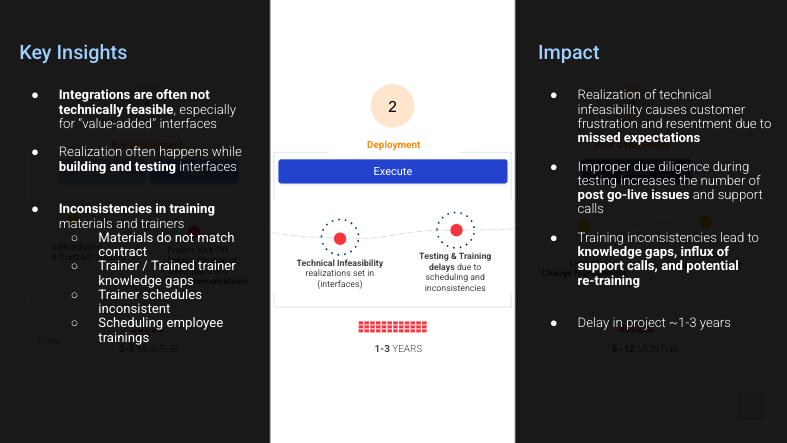
This report brought the research together into a form leaders and cross-functional teams could act on, making the experience issues, evidence, and next steps easier to align around.
Learning & Reflection

What I’d do differently:

  • Set clearer scoping boundaries upfront, including prioritizing the duration metric early.
  • Redesign group activities with a lighter facilitation load.
  • Integrate quantitative and qualitative workstreams earlier to avoid rework.